

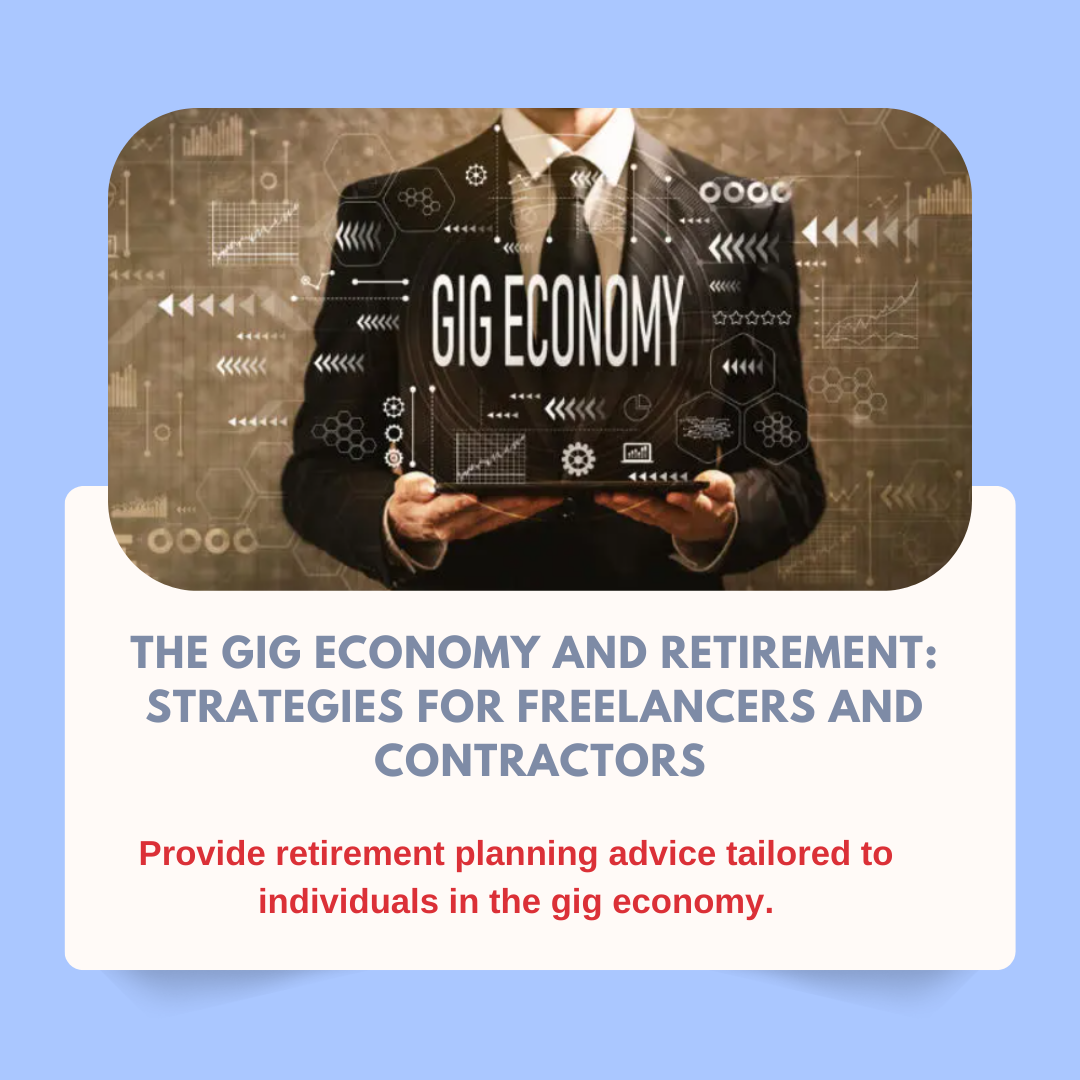
In a gig economy and retirement strategy that has overwhelmingly changed how we all work and gives flexibility and autonomy to millions of freelancers, contractors, and gig workers. It also comes with challenges in retirement planning. Quite the opposite of traditional employees, gig workers don’t get access to employer-sponsored retirement plans or benefits, so their financial future remains in their hands. The article describes retirement planning strategies for freelancers and contractors.
Understanding the Gig Economy
Indeed, the gig economy embodies many non-traditional working arrangements: freelance, contract jobs, on-demand services, and part-time. As such, although this flexibility and independence may be attractive to several people, gig economy and retirement plans must be more responsible concerning their financial planning since structured retirement benefits are absent here.
Challenges Faced by Gig Workers
- Irregular Income: Gig workers, unlike salaried employees, often bear fluctuating incomes that make it hard to save money regularly.
- No access to 401(k) plans or employer matching due to a lack of sponsored employer plans; personal retirement planning is necessary.
- Self-Employment Taxes: Gig workers pay self-employment taxes, making it hard to save for retirement.
Retirement Planning Strategies
To navigate these challenges, gig workers should adopt specific strategies to ensure a secure retirement.
1. Open a Retirement Account
Several retirement savings options are available to freelancers and contractors:
- Traditional or Roth IRA: This is an individual retirement account available to any person with earned income. The conventional IRA offers tax-deductible contributions, while the Roth IRA provides that the account holder can withdraw funds tax-free during retirement. In 2024, $6,500 can be placed into an IRA with an additional $1,000 catch-up contribution for investors aged 50 or older.
- SEP IRA: SEP-IRAs are retirement plans for self-employed people with much more generous contribution limits. In 2024, you may contribute up to 25% of your net earnings to the maximum of $66,000.
- Solo 401(k): can also be exactly like an individual 401(k), most recommended for sole proprietors. Renders have high contribution limits; hence employee can defer up to $22,500 (or $30,000 for those who are 50 years and above), and employer contributions can go up to 25% of net earnings, with a limit of totaling $66,000.
2. Automate Savings
Since your income may vary, you will want to set up an automatic transaction to go into your retirement account. Consider deferring a percentage of every single payment made to you into your retirement fund. Automating your savings can help overcome this temptation to spend rather than save.
3. Create a Budget and Stick to It
Budgeting manages irregular income. Be extremely careful in accounting for your earnings and expenditures and plan your budget—one that allocates your money to necessary spending and leaves room for some kind of regular contribution to retirement savings. Emergency funds should be kept for times of low income, which would avoid spending retirement savings on them.
4. Diversify Income Streams
Diversification of your sources of income will not only stabilize earnings but also help you save consistently. Therefore, it calls for diversifying clientele, services, or other passive income opportunities that increase one’s financial stability.
5. Invest for Growth
While saving is important, it’s also important to remember why saving isn’t enough on its own—investing your savings can grow over the long term. Gig economy and retirement money diversifies into a portfolio from which you’ll take money, comprising equities and bonds that will enhance growth possibilities while mitigating risk. You may also want to speak with a financial planner about creating an investment strategy based on your personal risk tolerance and vision for retirement.
6. Take Advantage of Tax Benefits
Gig workers should be aware of the different retirement account-related tax benefits. You can contribute to a traditional IRA, a SEP IRA, or a Solo 401(k) to reduce your taxable income—that will lower the taxes payable. Moreover, one can use most deductions available under self-employed earnings for deductions like home office expenses that further optimize your tax condition.
7. Plan for Health Care
Health-care expenses can be a drag in retirement. If you have a high-deductible health plan, you may wish to explore the availability of opening an HSA. Contributions are tax-deductible, earnings grow tax-free, and withdrawals for qualified medical expenses are tax-free. It could be a very tax-effective way to save for future health-related spending
Conclusion
Independent contractors and self-employed businesspersons take a hands-on approach to retirement planning. Freelancers and contractors will find a secure financial future by picking the proper retirement accounts, automating their savings, budgeting well, diversifying income streams, and investing wisely to reap tax benefits. Although these challenges exist, careful planning and commitment will help gig workers ensure a comfortable and well-heeled retirement.

Leave a Reply